



Squeaky treads underfoot, a wobbly railing, or worn stringers can turn a staircase from a daily convenience into a safety concern and a visual eyesore. Stair and railing repair in Des Moines is a common need in our city, where century-old Victorians in Sherman Hill and Drake share neighborhoods with 1950s ranch homes and newer two-story builds across Ankeny, Johnston, and West Des Moines. Central Iowa's freeze-thaw cycles, humidity swings, and the occasional impact from falling tree limbs all take their toll on wood stairs and railings. Whether your home has ornate period balusters that need restoration or a modern handrail that requires code compliance, we repair and restore staircases to safe, sound, and finished condition. We work on stairs old and new, and we explain what we find so you understand the repair.
Why Stair and Railing Safety Matters in Des Moines Homes
Stairs bear weight and motion every single day. Treads compress and shift, stringers (the angled supports that hold the treads) crack or split, and railings loosen as fasteners work free and wood shrinks with seasonal humidity changes. In Des Moines, the hard freeze-thaw cycles of winter and the humidity swings of summer accelerate wood movement, and neglected stairs become unsafe quickly. A wobbly railing or a soft tread is not just annoying, it is a liability and a sign that structural fasteners or the wood itself are failing. Addressing these problems early prevents a minor repair from becoming a major replacement job.
- We tighten loose balusters, newel posts, and railings by reinforcing fasteners and scribing joints to eliminate rocking.
- We repair or replace damaged treads, risers, and stringers to restore safe, level, and quiet stairs.
- We restore period railings in older homes and install code-compliant handrails in new construction or renovations.
- We assess whether a stringer or tread can be repaired or must be replaced, and we do the honest work either way.
A solid staircase is foundational to a safe and functional home, and we treat it that way.
Key info: Stair and railing alterations commonly require a local building permit, especially if you are modifying handrail height, baluster spacing, or structural support. Contact your local Des Moines building department to confirm permit requirements for your specific project before work begins.
How We Repair and Restore Stairs in Des Moines
Every staircase repair starts with a careful inspection. We walk the stairs, check for movement, test fasteners, and examine the wood for rot, cracks, or wear. We listen to what creaks and where, because the sound often tells us exactly which joint or fastener is loose. Once we understand what is failing and why, we propose the most cost-effective repair. Many stairs can be fixed without replacement, and we do that work. When wood is damaged beyond repair or a structural member has failed, we replace it with matching materials and finish.
- We inspect the entire staircase, including stringers, treads, risers, balusters, newel posts, and all fasteners and joints.
- We tighten or replace fasteners, reinforce loose joints with blocking or glue, and scribe balusters to railings for a tight fit.
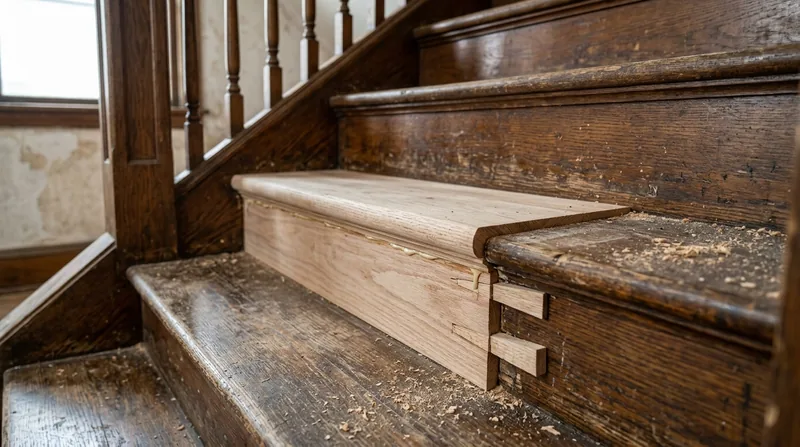
- We repair or replace individual treads, risers, or stringers, matching wood species and finish to the existing stair.
- We refinish stairs with stain, polyurethane, or paint, depending on the home's style and your preference.
- We document the work and provide a clear invoice so you understand what was done and why.
Our goal is to leave you with a staircase that is safe, quiet, and looks right for your home.
Example: A 1920s brick foursquare in Beaverdale had squeaky treads and a loose railing. We found that the stringer fasteners had loosened over decades of seasonal wood movement, and the balusters had shrunk away from the rail. We re-fastened the stringers with modern hardware, re-glued and re-fastened the balusters, and refinished the stairs. The result is a solid, quiet, original staircase that is safe for another hundred years. That kind of repair beats replacement every time.
Stair Repair Methods and Approaches
Different stair problems call for different solutions. A loose railing is not the same as a cracked stringer, and a worn tread is not the same as rot. We match the method to the problem and to the age and style of your home. The table below outlines the most common approaches we use and when each one makes sense.
| Approach | Description | Best For |
|---|---|---|
| Tightening and Re-Fastening | Remove loose fasteners, clean joints, re-glue if needed, and install new fasteners or larger hardware to lock the assembly tight. | Loose balusters, railings, newel posts, and squeaky treads where the wood itself is sound. |
| Wood Repair and Patching | Fill cracks, splits, or small areas of rot with epoxy or wood filler, then sand and refinish to match the existing surface. | Minor damage to treads, risers, or balusters where the structural integrity of the wood is not compromised. |
| Sistering or Reinforcement | Bolt a new support member alongside a damaged stringer or joist to restore load-bearing capacity without full replacement. | Cracked or weakened stringers where the staircase is still in use but needs structural reinforcement. |
| Component Replacement | Remove and replace individual treads, risers, balusters, or stringers with new wood, matching species, grain, and finish. | Rotted, severely cracked, or worn wood members where repair is not structurally sound or economically justified. |
| Period Railing Restoration | Carefully disassemble, repair, refinish, and reinstall ornate or historic balusters, newels, and railings to preserve character. | Victorian, Tudor, and Colonial Revival homes in Sherman Hill, Drake, and Beaverdale where original railings are part of the home's historic appeal. |
We assess each staircase on its own merits and recommend the approach that restores safety and appearance at the best value.
Stair and Railing Repair Cost in Des Moines: What to Expect
Stair and railing repair costs in Des Moines typically start around $600 for straightforward work like tightening loose railings, re-fastening balusters, or repairing a few squeaky treads. Larger jobs, such as replacing a full stringer, restoring a period railing, or repairing rot in multiple treads, run higher depending on the scope, the wood species, and the finish required. Several factors affect the final price: the number of stairs, the extent of damage, whether the wood can be repaired or must be replaced, access to the staircase, and the level of finish work needed. A simple tightening might take a few hours; a full stringer replacement can take two to three days or more. The best way to know what your job will cost is to get an on-site estimate from us or another qualified carpenter. We provide free estimates within 24 hours, and we recommend getting two or three estimates so you can compare scope, approach, and price. Visit our pricing page for more detail on how we structure costs, or call us at (515) 762-6553 to discuss your specific staircase.
We also work on related structural and finish carpentry across Des Moines. If your staircase damage is tied to wood rot or dry rot in a landing or support structure, we can address that as part of the same project.
Stair and Railing Repair Near Me: What to Look For When Hiring a Carpenter in Des Moines
Finding a trustworthy carpenter for stair and railing repair in Des Moines means doing a little homework. You want someone who understands wood, who can diagnose the real problem, and who will repair rather than replace whenever the wood justifies it. Here are the things to check before you book a job. First, confirm that the carpenter is fully insured and can provide proof of coverage. Second, ask for references from recent stair or railing jobs in Des Moines or surrounding areas, and follow up with those references. Third, get multiple estimates (two or three) and compare not just price but scope, method, and timeline. Fourth, if your stairs are part of a historic home or if you are making structural changes to the staircase, ask whether a permit is required and who will handle the permit process. Fifth, if your neighborhood or home has HOA rules or if your home is in a historic district, check whether there are restrictions on railing style or materials before you commit to a repair or replacement. We are fully insured and have been in business since 2016. We provide free estimates, explain our work, and handle permits when required. If you are ready to get started, contact us for a free estimate at (515) 762-6553.
Stair & Railing Repair in Des Moines: Pricing Guide
| Service | Price | Details |
|---|---|---|
| Loose railing or banister tightening | Starting at $600 | Re-fastening, re-gluing loose joints, and reinforcing balusters, newel posts, or railings for a solid feel |
| Squeaky tread repair | Starting at $800 | Identifying and tightening the source of creaking, re-fastening stringers, adding blocking or shims to stabilize treads |
| Damaged tread or riser repair or replacement | Starting at $1,200 | Repairing cracks or wear with epoxy or wood filler, or replacing the component with matching wood and finish |
| Cracked or damaged stringer repair or sistering | Starting at $1,800 | Reinforcing or replacing the structural support beam that holds the treads, including fastening and finishing |
| Period railing restoration or full staircase overhaul | On estimate | Historic railing disassembly, repair, refinishing, and reinstallation, or major multi-component replacement work requires on-site assessment |
| Free estimate | No obligation | Response within 24 hours at (515) 762-6553, includes inspection, diagnosis, and repair or replacement recommendation |
Indicative pricing, the exact cost depends on square footage, finish, and site access. Free personalized estimate within 24h at (515) 762-6553.


